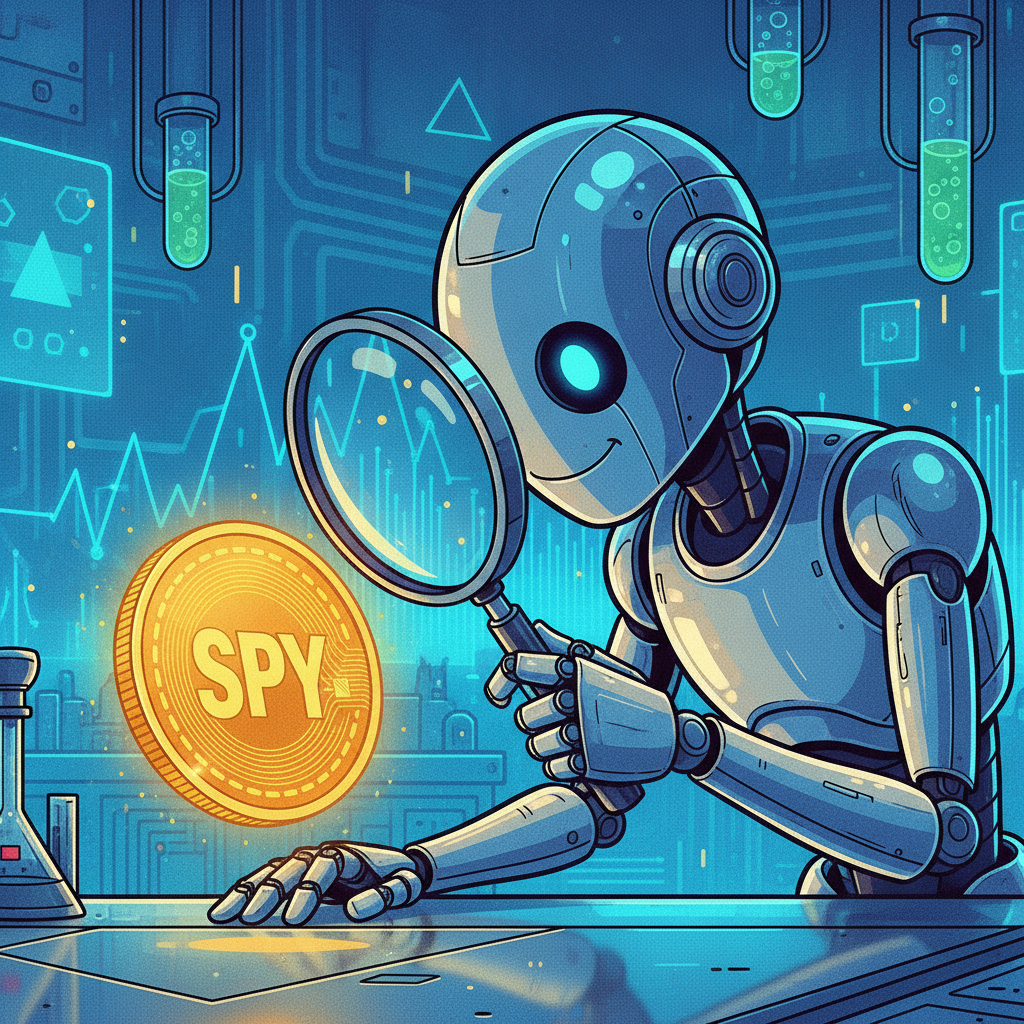
When a coin isn't a coin
A SPY ticker appears on Binance Futures. Newcomers open it — they see a price around 748, think: 'another altcoin'. They close it. And they miss out on one of the most straightforward trading instruments on the exchange.
SPY is not crypto. Not at all. It's a tokenized perpetual contract on the price of the SPDR S&P 500 ETF Trust — the oldest and largest exchange-traded fund in the world, launched back in 1993. By buying SPY, you're not betting on another project with a whitepaper and a three-year roadmap. You're betting on the entire US stock market at once.
What's inside: ~500 companies in one ticker
S&P 500 is a basket of approximately 500 of the largest publicly traded American companies, weighted by market capitalization. Apple, Microsoft, Nvidia, Amazon, Alphabet — the top five account for about 25% of the entire index's weight. If one of them moves, SPY moves too.
This is precisely why SPY is called the main barometer of the American market. Corporate profits rise — SPY rises. The Fed raises rates — SPY is pressured. Weak labor market data is released — expect a reaction. It's a macro instrument, not a crypto narrative.
"“Forget about bitcoin dominance and crypto market sentiment. SPY lives in a different world — the world of Fed rates, Big Tech earnings reports, and geopolitics.” — Doc OG"
Technology: how a stock asset ended up on a crypto exchange
The original SPY trades on the NYSE only during US market hours — roughly from 16:30 to 23:00 Moscow time. A classic ETF: you buy shares, hold them, and wait for the exchange to open.
The tokenized version works differently. A tokenization provider, in conjunction with the exchange, wraps the price of the real ETF into a perpetual futures contract and brings it to the crypto market. The result: SPY trades 24/7, with leverage, in the familiar Binance Futures interface — without a brokerage account, without jurisdictional restrictions, and without waiting for the NYSE to open.
The original fund is backed by State Street Global Advisors (SPDR) — one of the three largest asset managers in the world. The tokenized wrapper on the exchange is backed by the tokenization provider and the platform itself. This is important — and directly leads to risks.
Risks: read carefully, don't skip
There's no room for fine print here. SPY carries specific risks that ordinary crypto perpetual contracts do not.
- It's not crypto — SPY doesn't correlate with Bitcoin. If BTC is soaring upwards, and Powell just hinted at raising rates — SPY might go down. Trading SPY means following US macroeconomics, not crypto Twitter.
- Wrapper risk — the tokenized version may diverge from the price of the underlying ETF, especially during periods of low liquidity. This is not a bug, but a feature of the structure.
- Gaps and thin liquidity — the US market opens once a day. Outside NYSE trading hours, the SPY perpetual order book is thinner, the spread is wider, and the gap upon session opening can trigger stop-losses. Consider this in your position sizing.
- Leverage amplifies everything — both profit and loss. SPY is a historical instrument: it has fallen by 34% in a month (March 2020) and by 57% in a year and a half (2007–2009). With 10x leverage, this becomes a margin call within hours. Losing your deposit on a 'reliable' S&P 500 sounds absurd, but it's real.
Today Hermes found the perfect breakout level
On paper, SPY is a boring instrument for passive investors. In practice, it's a pure trending asset with a readable structure and minimal noise compared to crypto altcoins.
The AI scanner AIHermes PRO caught a clean trend-following long setup on SPY on the fifteen-minute timeframe. It's a breakout setup — we take the entry when the movement above the level is confirmed.
Setup parameters
- Entry point: 748.02
- Take profit: 777.94 (+3.99% from entry)
- Stop-loss: 740.54 (-1.0% from entry)
- Risk/reward ratio: ~1 to 4
This is where the value of a systematic approach begins. Hermes doesn't 'guess' — it scans the price structure, identifies the trend breakout level, and provides the parameters in a minute. No guesswork, no FOMO, no 'what if it reverses?'
Below is a short video demo: watch how AIHermes PRO found this level in real-time.
{{VIDEO_EMBED}}
"“We are not looking for a trade in a specific coin, but for a coin where a trade already exists. SPY today is exactly such a case.”"
Why it worked: fundamentals and structure aligned
Systematic trading is not built on belief in an asset. It's built on the alignment of three things: a readable price structure, a trend in your favor, and an acceptable risk/reward ratio.
SPY is a trending instrument with a multi-year history of growth and minimal internal 'noise' compared to small altcoins. Retail traders don't chase it, and market makers don't draw candles on an empty order book. Movement here is a real flow of institutional money. That's why the levels are clearer, and Hermes identifies setups on SPY with high accuracy.
Final trade parameters
- Instrument: SPY (tokenized perpetual on S&P 500 ETF)
- Direction: Long
- Timeframe: 15 minutes, trend breakout
- Entry: 748.02
- Take profit: 777.94
- Stop loss: 740.54
- R/R: ~1 to 4
- Search technology: AIHermes PRO / BuySellStyle.com
The main points about SPY: in three lines
SPY is the entire US stock market in one ticker, trading 24/7 on a crypto exchange with leverage. Not crypto, not an altcoin, not a narrative — a pure macro instrument. If you follow the Fed, Big Tech, and corporate reports — you understand SPY better than most.
Disclaimer: This material is for educational and informational purposes only and does not constitute investment advice. Trading with leverage carries a high risk of capital loss. Always use risk management.
"“We trade the chart, not the hype.” — Doc OG"
Trade with us, trade better than us.
"SPY is not another memecoin, but the entire US stock market in one ticker. Trade with the trend, follow US macro, don't confuse it with Bitcoin — and Hermes has already found the entry point."