I saw the SOPHUSDT ticker on Binance Futures and thought it was another coin – and I was almost wrong. Because here the underlying asset is not a blockchain, not a token, not a DAO. Here it's a Swiss company from NASDAQ that makes AI for analyzing the DNA of cancer patients. The sector is currently one of the hottest in medtech. Let's break it down: what it is, how the mechanism works, and how to trade when there's almost no history on the chart.
What is SOPHUSDT and how does it work
SOPHUSDT is a perpetual contract on Binance Futures. Not a coin, not a token, not a share in the company. It's a synthetic instrument tied to the quote of SOPHiA GENETICS SA (NASDAQ: SOPH). Settlement is in USDT, counterparty is Binance.
The mechanics are the same as with BTCUSDT or ETHUSDT: you open a long or short, pay or receive funding every eight hours, and your PnL is calculated from the price movement of the underlying asset. Only instead of Bitcoin, it's a stock from an American exchange. There are no actual shares in hand, no voting rights, no dividends. There's the price and its movement.
An important nuance that trips many up: NASDAQ operates from 9:30 AM to 4:00 PM EST (4:30 PM to 11:00 PM MSK). When the American exchange is closed, the SOPHUSDT quote on Binance freezes at the last price. The opening of the next session can cause a gap – a sharp jump or drop without intermediate candles. If you trade at night MSK time, take this into account with your stops.
What SOPHiA GENETICS does
The company is based in Switzerland and has been trading on NASDAQ since 2021. Its product is the SOPHiA DDM (Data-Driven Medicine) cloud platform: hospitals and laboratories connect to it, upload patients' genomic data, and receive clinically standardized interpretations – in oncology, rare diseases, cardiology, and reproductive health.
The business model is SaaS plus per-analysis fee: the client pays for each processed sample or via subscription. This is recurring revenue – predictable, with potential for gross margin growth as the base accumulates. Currently, over 750 hospitals and labs in 70+ countries are connected to the platform.
The key competitive advantage is not the algorithm itself, but the accumulated clinical data. The more samples processed through the platform, the more accurate the models become. This is a classic network effect: a new participant improves the system for everyone. Competitors like Foundation Medicine (Roche), Tempus AI, and Illumina are strong, but SOPHiA differentiates itself through a vendor-agnostic approach: it works with any sequencers, not tying the client to specific hardware.
Honestly about the downsides: the company is operationally unprofitable. Money is invested in R&D and commercial scaling – a standard story for growth-stage medtech. The risk is a slowdown in new connections or price pressure from Roche/Illumina with their resources.
Why the sector is hot right now
Health Tech / AI-driven Genomics Analytics is not a narrative for narrative's sake. It's backed by three real drivers.
First: the cost of full genome sequencing has dropped orders of magnitude over the past decade – this has opened up the market for mass clinical diagnostics, not just research labs.
Second: the FDA and EMA continue to expand indications for targeted oncology drugs, each requiring CGP (comprehensive genomic profiling) testing before prescription. More approved drugs mean more mandatory tests, meaning more samples processed through the platform.
Third: insurance coverage for genomic diagnostics is expanding in both the US and Europe. Money is starting to flow into the sector not from venture capital, but from insurance – this is a different category of stability.
On paper, everything adds up. In practice, the company still has to prove it can convert revenue growth into operating profit. If you're following SOPH, keep an eye on the dynamics of ARR (annual recurring revenue) and gross margin in each quarterly report.
How to read the chart when there's almost no history
The SOPHUSDT ticker was added to Binance in June 2026. The history on the futures chart is in days, not months. Building technical analysis on this chart is pointless.
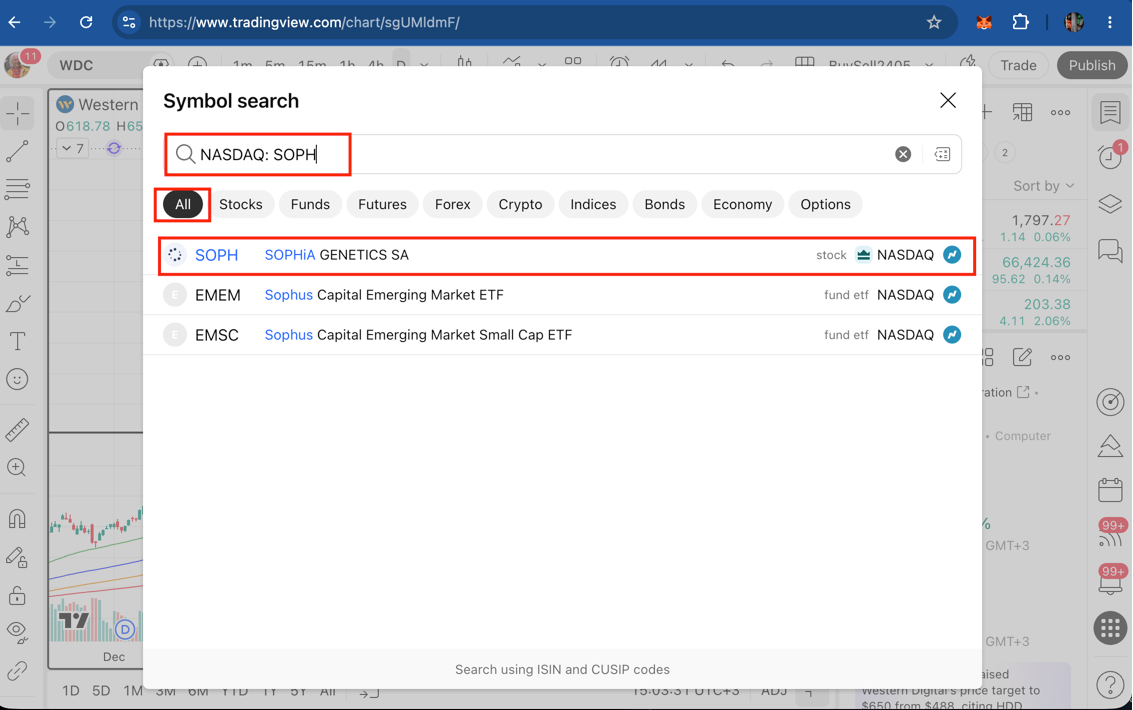
What to do: open TradingView or Yahoo Finance, search for NASDAQ:SOPH, switch to the daily timeframe. That's where the history is, and that's where the relevant levels are.
Current situation as of June 15, 2026:
- Price: $5.01
- 52-week range: $2.89 – $5.52 (price is currently 81% of the range – closer to the upper bound)
- MA50: $4.99 – price is 0.4% above
- MA100: $4.90 – price is 2.2% above
- MA150: $4.85 – price is 3.3% above
- MA200: $4.64 – price is 8.1% above
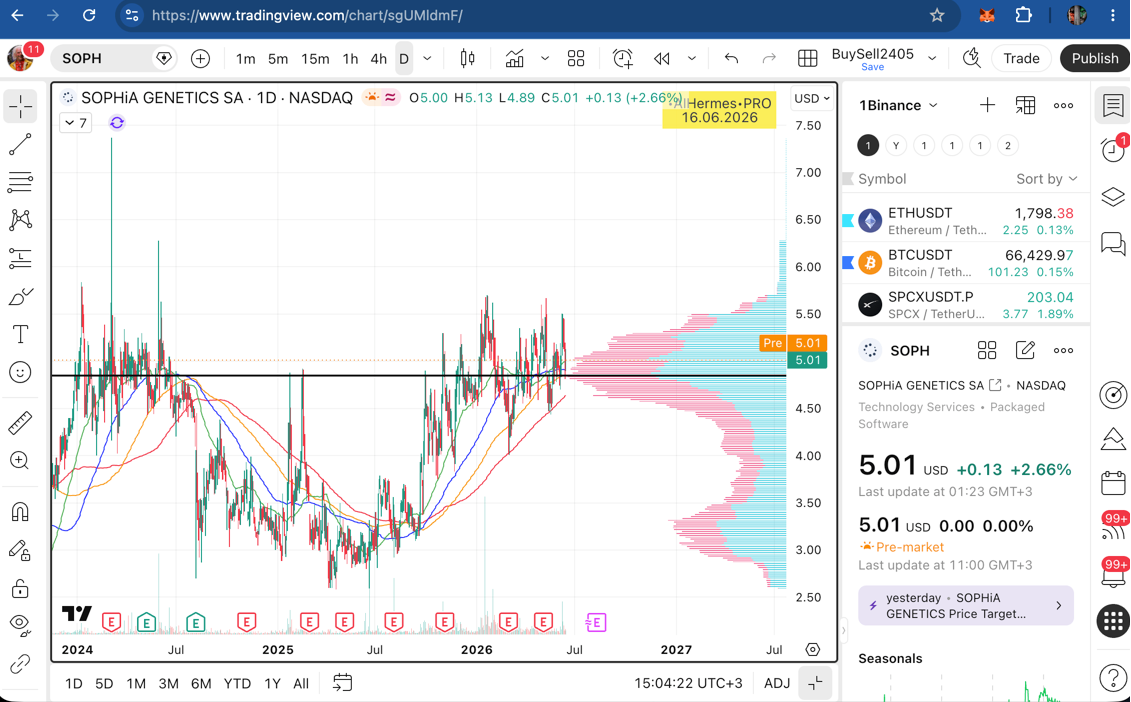
Being above all four moving averages simultaneously indicates a strong uptrend on the daily chart. The model is simple:
- Long setup: retest of MA50 or MA100 from below while maintaining structure – an entry point with a clear stop.
- Caution: a drop below MA50 ($4.99) is the first sign of weakness; reconsider your position.
- Exit from long-bias: closing the day below MA200 ($4.64) – the long-term picture changes.
A separate tradable pattern is the post-earnings gap. Quarterly earnings are released four times a year. After publication, the price often jumps or drops at the opening of NASDAQ. This is a readable signal with proper preparation: if you know the date, you prepare; if you don't, you get caught in a gap without a stop.
Advantages and risks: an honest balance
Factors in favor
- Above all MAs – technicals confirm demand.
- Data network effect creates a real moat against competitors.
- Growth in CGP testing structurally supports revenue.
- Vendor-agnostic approach opens the market without tying to a competitor's ecosystem.
- SaaS model provides revenue predictability and operational leverage.
What could break the story
- The company is unprofitable – any slowdown in revenue growth will be sharply punished by the market.
- Roche and Illumina with incomparable resources could push down the price.
- Regulatory uncertainty in AI medicine – new FDA/EMA requirements for diagnostic algorithms.
- Gap risk when trading outside NASDAQ hours: the quote freezes – you don't see the real movement.
- Short history on Binance Futures provides no support/resistance levels – trade only using the NASDAQ chart.
""Fundamentals and technicals are on the same side for now. This doesn't mean 'buy everything now' – it means that a long setup with a proper retest exists." - Doc OG"
Conclusion
SOPHUSDT is not a crypto coin with a whitepaper, not a memecoin, not an ecosystem token. It's synthetic access to the stock of a Swiss Health Tech company with real revenue and real customers. The mechanics are standard Binance perpetuals, funding, settlement in USDT. Everything else is like any equity: quarterly reports, macroeconomics, competitors.
Read the chart on NASDAQ:SOPH daily. The price is above all four MAs – this is an uptrend. Look for a retest, set a stop below the nearest moving average, and remember the gap at the opening of the American session.
The instrument is workable. Work with it as an instrument.
""We trade the chart, not the marketing hype." - Dok OG"
"SOPHUSDT is not a crypto speculation, but synthetic access to a growing Health Tech name with a strong narrative. The price is above all four moving averages: fundamentals and technicals are on the same side for now. Trade the levels – not the hype."