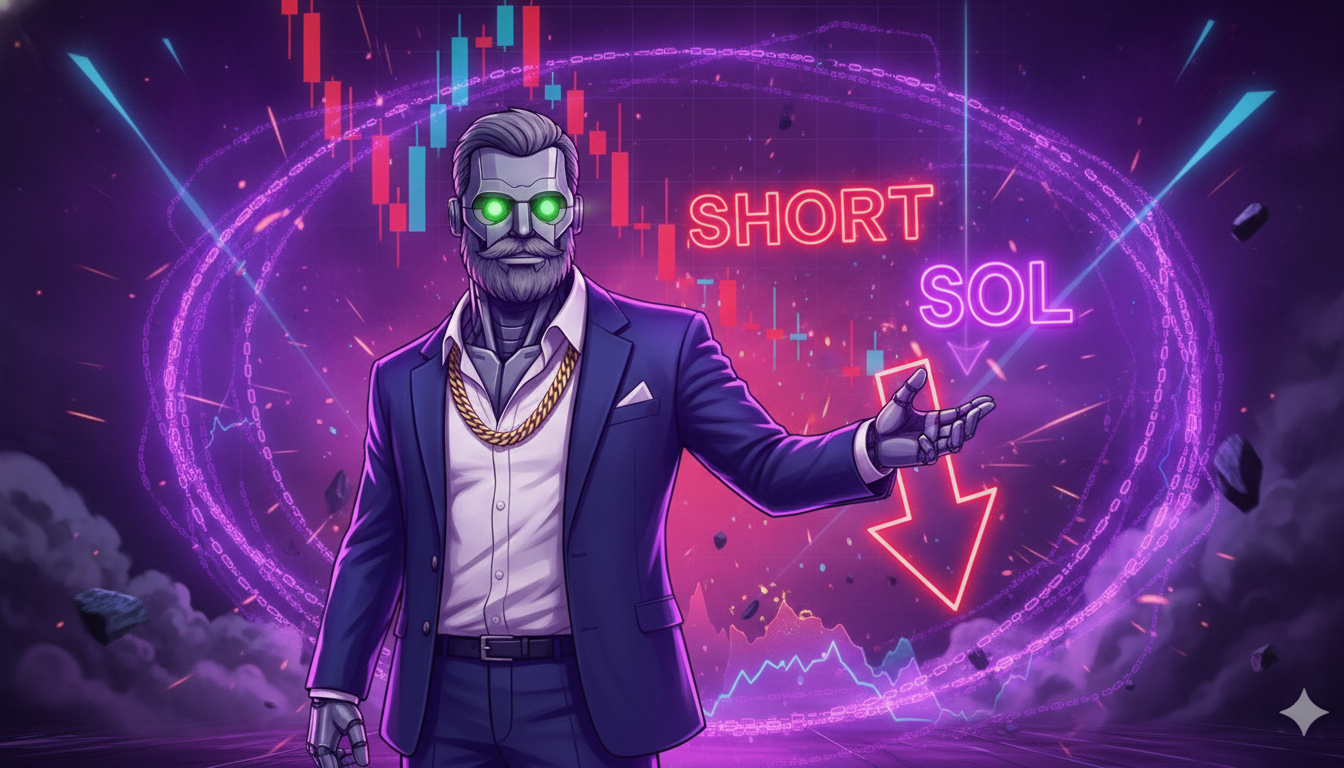
Traders say SOL is 'too wild.' Too volatile, too unpredictable, too scary to hold overnight. The irony is that this is precisely why it's convenient to trade. High volatility with deep liquidity isn't a problem; it means tradable levels, clear bounces, and setups that play out without vague 'maybe up, maybe down' scenarios. Let's break down what's happening with SOL right now: where the price has been, where it stands, and why AIHermes PRO is issuing a SHORT signal.
What is SOL and Why is it Relevant?
Solana is an L1 blockchain originally built around one idea: speed at any cost. Thousands of transactions per second, sub-cent fees, an architecture that can handle load where Ethereum gets bogged down in queues. Ideal on paper. In practice, it's had several high-profile network outages, emergency restarts, and a reputation for being 'fast but unreliable.'
But here's the thing: the market has long since made its verdict. DeFi protocols, NFT platforms, meme coins – all of this is now running on Solana in industrial volumes. SOL's tokenomics are tied to real demand for blockspace: the more active the network, the more upward pressure on the price. This isn't 'we're launching soon'; it's a working infrastructure with real users.
By daily trading volume, SOL is second among altcoins after ETH. $1.5 billion per day isn't a pump on an empty order book. Such liquidity eliminates fakes: support and resistance levels hold because real money is behind them, not just a manipulator with a couple of bots.
Where Does the Volatility Come From, and Why Is It a Plus?
SOL correlates with BTC, but with a multiplier. When Bitcoin drops 5%, SOL often drops 10% or 12%. When the market turns around, SOL bounces first among top L1s. Beginners see this as chaos. Experienced traders see something else: the amplitude is large, but the structure repeats.
This is where working with levels begins. With $1.5 billion in daily volume, every significant price level is 'pressed' by real order flow. This means supports hold, resistances work, and stop hunts happen for understandable reasons – not because someone is drawing candles, but because the crowd's stops have accumulated there.
"SOL's volatility isn't a bug; it's a feature. Large amplitude with a deep order book provides exactly what a trader needs: predictable setups with a good risk/reward ratio."
Current Signal: AIHermes PRO Says SHORT
Our AIHermes PRO system is currently issuing a SHORT direction for SOL. Let's break down why this isn't just a downward arrow, but a specific logic.
After a strong impulse in the first quarter, SOL's price has entered a zone of historical resistance. Buyers have tried to push above the level multiple times – each time encountering pressure and pulling back. Volumes on attempted breakouts are weak. Moving averages have turned: the 50MA is now above the price and acting as a ceiling, pressing down. The structure says one thing: the market isn't ready for a new upward impulse until this ceiling is broken.
Going long on SOL here is like catching a falling knife. The network's fundamentals haven't changed, but the technical picture is against buyers.
Key Levels: Where the Price Has Reversed
According to our system, three zones are currently relevant for SOL:
- Resistance – the zone from which the price has reversed downwards three times. Here, seller pressure is maximal, and volumes on breakouts haven't confirmed the move. Until this level is taken with a daily close above it, it remains a ceiling.
- First Support – an intermediate zone where a technical bounce can be expected. This is often where short sellers' stops will be cleared before further decline. Be cautious.
- Deep Support – a historical level with multiple touches. This is the target for a SHORT position and a potential area to look for a long with good R/R (risk-to-reward ratio).
Specific figures for each level are available in the coin's card on AIHermes, updated in real-time as the price moves.
Trading Plan: Entry, Stop, Target
We have a signal. Now, what to do with it. Here's the trading plan for the current SHORT setup:
- Entry Point: The resistance zone, approached from below with confirmation (weak breakout volume, reversal candle on H4 or daily chart).
- Stop-Loss: Above the resistance zone with buffer for stop hunting – the market likes to shake out stops before reversing; account for this.
- Target 1 (~60%): The first support level – take partial profits here, remove risk.
- Target 2 (~40%): The deep support level – for those willing to hold the position if it develops favorably.
The risk/reward ratio for this setup, with a proper entry, is no less than 1:2.5. This isn't 'maybe it'll work'; it's math that pays off in the long run.
"'On paper, everything looks clean. In practice, wait for confirmation; don't jump the gun.' — Doc OG"
Risks: What Could Derail the Setup
An honest analysis without discussing risks would be an advertisement, not analysis. Here's what could go wrong:
- BTC Reversal Upwards – If Bitcoin sharply moves to new local highs, SOL will likely follow, closing the short at a loss. Monitor the correlation.
- Positive Solana Narrative – A major listing, partnership, or network upgrade. News can pump the price through resistance without technical confirmation. 'Buy the rumor' works here too.
- Stop Hunt Before Decline – The market might first clear short sellers' stops above the resistance level, and only then reverse downwards. This is precisely why the stop-loss must have a buffer, and the entry should be on a pullback, not a breakout.
- Prolonged Flat Market – The price grinds sideways between support and resistance, the setup doesn't play out, and commissions eat away at the capital. In such a case, exit to cash and wait.
Risk management is mandatory. Never risk more than 1-2% of your capital on a single trade. SOL can provide exponential gains in both directions – and this applies to losses too.
Conclusion
SOL is not a 'buy and forget' asset. It's a tool for those who know how to work with levels and read volume. Liquidity provides a clear picture, volatility provides amplitude – together, they create a workable setup with understandable mechanics.
Currently, AIHermes PRO sees SHORT. The price structure, volume behavior, and moving average positions – everything points against buyers. We await confirmation at resistance, enter according to the plan, and maintain the stop-loss.
"Trade the chart, not the hype around 'the fast blockchain.' — Doc OG"
"SOL is not an asset for the faint of heart, but it's precisely its volatility that draws the cleanest levels among L1s. The AIHermes PRO signal currently indicates SHORT – ignoring it is suicidal until the price provides a different setup."