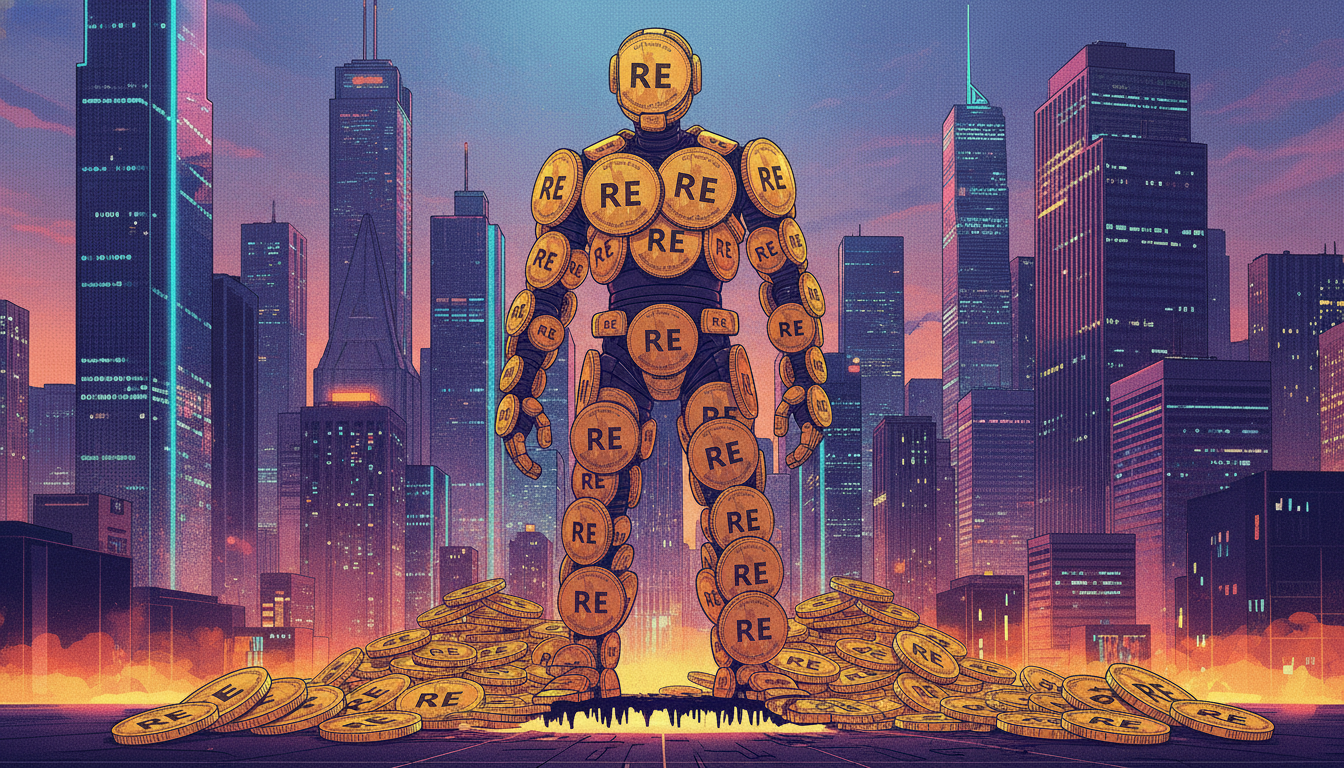
When "RE coin" appears in a search, the first result might lead you to a 2017 criminal case. The second leads to a coin on Binance with significant trading volumes. These are two completely different projects, and confusion between them has cost people money. Let's separate them once and for all.
What is the "Real Estate Coin" from the picture – and why it's important to know
REcoin from 2017. The creator is Maksim Zavalny, a businessman from Brooklyn. The project's motto sounded appealing: "Leadership of Tomorrow." Its positioning was "the first cryptocurrency backed by real estate." On paper, everything looked solid: ICO, tokens, a claimed fundraising of $2 to $4 million, a team of lawyers, brokers, and accountants who would invest the funds in real estate.
In reality, he hired no one. Absolutely no one. Not a single lawyer, not a single broker, not a single consultation. No real estate was purchased. According to the SEC, the tokens themselves did not actually exist. They actually raised about $300,000 – several times less than the stated figures. Simultaneously, Zavalny was running a second scheme – Diamond Reserve Club (DRC World), "backed by diamonds." The logic was the same: the appealing word "backed" + a real asset in the name + zero real asset inside.
This is not just the story of one scammer. In September 2017, the SEC filed a case against REcoin – the agency's first-ever case of ICO fraud. The first conviction for an ICO also went to Zavalny. He pleaded guilty. He received 18 months in prison. The case became a precedent that lawyers still cite today: ICO tokens can be securities – and selling them without registration leads to jail.
""Backed by real assets" is a statement. Not proof. REcoin taught the market this lesson at the cost of the first criminal sentence in crypto history."
RE Protocol — a completely different story
Now, let's talk about what's trading on exchanges right now.
REUSDT appeared on Binance on June 18, 2026. The price is around $0.72, with notable trading volumes. This is RE Protocol – an on-chain capital market connecting stablecoin liquidity with regulated reinsurance. It's from the world of RWA (Real World Assets on the blockchain), but not from the world of real estate. It has no legal, technological, or historical connection to Zavalny's defunct REcoin.
RE Protocol has a different narrative: blockchain-based insurance capital, institutional reinsurers, and stablecoin pools as a liquidity source for the traditional market. It sounds less hyped than "real estate," but it's conceptually more complex and potentially closer to real financial infrastructure.
The confusion between tickers works against you. When a Telegram channel writes "RE is mooning," it's not always clear which RE is being discussed – and this isn't accidental. It's a feature of the market where one ticker can carry the reputational baggage of a seven-year-old defunct project.
Why it took off – and what's behind it
REcoin 2017 took off on the ICO hype wave and the word "real estate." In 2017, ICOs raised money on an industrial scale, regulators hadn't yet formed a clear stance, and the word "backed" acted as a marketing multiplier. There was no technological breakthrough. There was a narrative + a nice logo + zero verifiability of promises.
RE Protocol 2026 is a different context. The RWA narrative is currently one of the hottest in the industry. BCG projects trillions in tokenized assets by 2030. Institutional money is entering cautiously under this narrative, while retail investors jump in blindly. The listing on Binance provided visibility and volume. The growth began.
But here's the question: reinsurance is not a sexy story for retail investors. It's B2B infrastructure with long verification cycles. Where the trading volume at listing comes from is an open question.
What doesn't add up – red flags for both
Regarding REcoin (historically, as a lesson)
- "Team of specialists" – zero people hired
- Claimed fundraising of $2–4 million – actually $300,000
- Tokens that were "backed" – SEC stated they effectively didn't exist
- Parallel scheme with diamonds – a classic sign of serial fraud
Regarding RE Protocol (for those looking now)
- The "RWA + reinsurance" narrative is complex for independent verification: where is the audit of reserves?
- Regulated reinsurance implies licenses – have they been verified?
- High trading volumes upon listing on Binance – wash trading or real demand?
- Team and legal structure: who are the counterparties on the traditional insurance side?
Risks – no sugarcoating
- Ticker confusion. Search engines display a defunct fraudulent project alongside a live one – this affects reputation and understanding of the asset's history.
- RWA narrative without verification. "Backed by real assets" requires looking at audits, not just whitepapers.
- Listing pump. The first few days after Binance listing are a classic zone for FOMO investors who enter on hype.
- Complex product. Reinsurance is not DeFi farming; retail investors cannot independently verify the reality of contracts.
- Unknown overhang. Without data on tokenomics and unlocks, it's unclear who holds significant amounts and is waiting for an opportunity to sell.
- Regulatory risk. The RWA sector is under SEC scrutiny – the precedent of REcoin 2017 is still relevant in legal practice.
Technical perspective
At the time of listing, REUSDT went up on volume – a classic listing impulse. Initial support levels form quickly, but without trading history, the 50MA and 200MA do not yet provide a signal. Trading a listing impulse can be done with a short horizon and a strict stop-loss. Holding it as an RWA investment without verified reserve data is a different story, and far less straightforward.
Conclusion: verify the team, not the logo
Two projects. One ticker. The word "real assets" at the core of each.
REcoin 2017 is a cautionary tale. The SEC's first ICO case, the first conviction, 18 months in jail, zero real estate. A story you need to know before investing in any RWA token with a catchy narrative.
RE Protocol 2026 is a live project on Binance with trading volume. It has no relation to real estate, but it does relate to reinsurance. The narrative is more complex and potentially more interesting, but the verifiability of its claims remains the main question.
Before investing: look at the team, licenses, and reserve audits. Don't trust the word "backed" – history has already shown its worth without documentation.
""Backed by real assets" are the most expensive words in crypto. REcoin was the first to demonstrate this. Trade facts, not narratives." — Dok OG"
This material is for informational purposes only and does not constitute investment advice. Trading cryptocurrencies involves a high risk of capital loss.