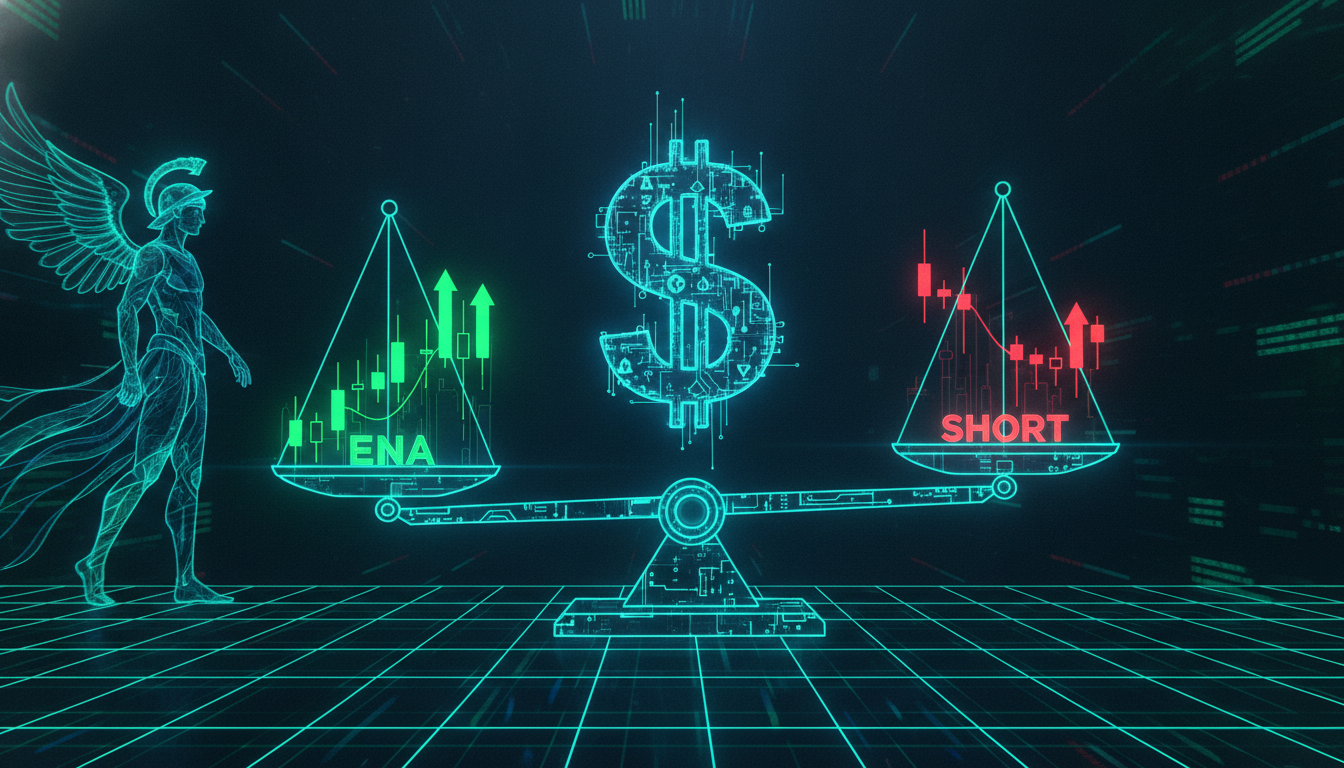
Most people hear 'stablecoin' and think: dollars in a bank, everything is clear. Ethena did it differently. No bank, no fiat — just crypto, exchange hedging, and math. Sounds crazy. But behind it are Dragonfly, Binance Labs, and Arthur Hayes. So let's break down how it works — and why you should be cautious with ENA right now.
What is USDe and why is it needed
Ethena is a DeFi protocol that issues USDe. Not a stablecoin in the classic sense, but a 'synthetic dollar' — a fundamentally different construct.
USDT and USDC work simply: Tether or Circle hold real dollars in bank accounts, and they print tokens against them. If regulators pressure them, the account is frozen. Ethena removed the bank from the equation entirely.
USDe's backing is cryptocurrency (ETH, BTC, liquid staking tokens) plus a hedge on a derivatives exchange. This combination is what creates the 'synthetic dollar'.
Mechanics: Delta-neutral in simple terms
Here's how it works in practice. Let's say 1 ETH worth $3,000 enters the protocol.
Simultaneously with receiving ETH, the protocol opens a short position on a perpetual futures contract (perp) for the same amount — $3,000. What happens now as the price moves:
- ETH grows to $4,000 — the spot position gains +$1,000, the perp short loses -$1,000. Total: zero.
- ETH drops to $2,000 — the spot position loses -$1,000, the perp short gains +$1,000. Total: zero again.
The collateral value remains around $3,000 regardless of market movements. This is what a delta-neutral position is — the exposure to price changes (delta) is zero. This is why USDe maintains its peg to the dollar without fiat in a bank.
Elegant. And this isn't marketing — it's a working engineering construct.
Where does the yield come from
This is where it gets interesting. The protocol earns from two sources, and both amounts go to holders of sUSDe — staked USDe (the 'Internet Bond,' as Ethena calls it).
The first source is ETH staking. The underlying collateral is partially represented by liquid staking tokens (stETH and similar), which themselves generate about 3–4% annually from the Ethereum network.
The second source is the funding rate. In the perpetual futures market, there's a funding mechanism: when the market is dominated by longs (bull market), they periodically pay shorts. Since Ethena holds short positions, it receives these payments. During peak periods, the total yield of sUSDe has surged to 20–30% annually. This became the main magnet for capital and drove USDe supply to one of the largest in crypto.
On paper — printing money out of thin air. In practice — it only works reliably in a bull market.
Who is behind the project
Serious money is behind Ethena Labs. The founder and CEO is Guy Young. Among the investors are: Dragonfly, Binance Labs, Bybit, OKX Ventures, Franklin Templeton.
Maelstrom deserves special attention — the fund of Arthur Hayes, former CEO of BitMEX. Hayes publicly promoted the idea of a synthetic dollar long before Ethena's launch. His involvement isn't just a line in a pitch deck: he understands perpetual futures mechanics better than most people in the industry.
Such a list of investors indicates one thing: the protocol has been vetted by people who know how to assess risks.
ENA — the protocol's token, not USDe itself
An important distinction that many confuse.
USDe is the product, the synthetic dollar. ENA is the governance token of the Ethena protocol itself: voting on parameters, incentives for participants, managing development. By buying ENA, you are not directly buying a share in the protocol's yield — you are buying voting rights and a bet on the ecosystem's growth.
This is neither good nor bad. You just need to understand it before diving in.
Risks: What the whitepaper doesn't tell you
Time to come back down to earth.
Risk #1 — negative funding rate. This is the model's main Achilles' heel. In a bear or neutral market, the situation reverses: more shorts, fewer longs — and now shorts pay longs. Ethena goes from receiving funding to paying it. The model's yield decreases, and in extreme cases, turns negative. The protocol's reserve fund is created precisely to cover such periods — but the size of this buffer is finite.
Risk #2 — exchange risk. Short positions are held on centralized exchanges (Binance, Bybit, OKX). This means counterparty risk: problems with the exchange mean problems with the hedge. This isn't hypothetical — the market saw what happens to centralized platforms in 2022.
Risk #3 — USDe de-peg. During sharp one-sided market movements or liquidity crises, the mechanism might not be able to rebalance in time. USDe is not USDC; there's no government insurance.
Three real risks. All three are not scare tactics, but working scenarios.
What's happening with the ENA chart
The high yield narrative is cooling down — and with it, the token price is cooling down too.
According to AIHermes ratings, ENA is currently trending downwards. Daily, four-hour, and fifteen-minute timeframes show a downtrend. The funding rate on the market no longer generates the double-digit annual yields that attracted capital in 2024. The bearish context is also pressuring the token itself.
Going long on ENA now means going against the trend. It's suicide with sellers still active and a weak narrative.
""On paper, USDe is one of the smartest constructs in DeFi in recent years. In reality, its yield directly depends on market sentiment. The market isn't in the right mood right now." — Dok OG"
Conclusion
Ethena is not a scam and not an empty shell. The delta-neutral mechanics actually work, the team is strong, and the investors are not random people. USDe as a product has shown it can scale.
But ENA as a trading asset is currently under pressure: funding is cooling, trends are down, the 'high yield' narrative is collapsing. It's worth keeping an eye on the protocol — but entering at current levels against the trend is not advisable.
Trade the chart, not the whitepaper. — Dok OG
This material is not financial advice. Trading cryptocurrencies involves high risks.
"A smart engineering construct with real money behind it — but currently, the high yield narrative is cooling along with the funding. ENA is in a bearish trend: the idea is beautiful on paper, but in reality, the fundamentals are against entering."